

Evolution of High-Voltage Residential Energy Storage
Technical Principles, Performance Innovation and Economic Restructuring — An engineering deep-dive into why 150V–600V architectures are displacing legacy 48V systems.
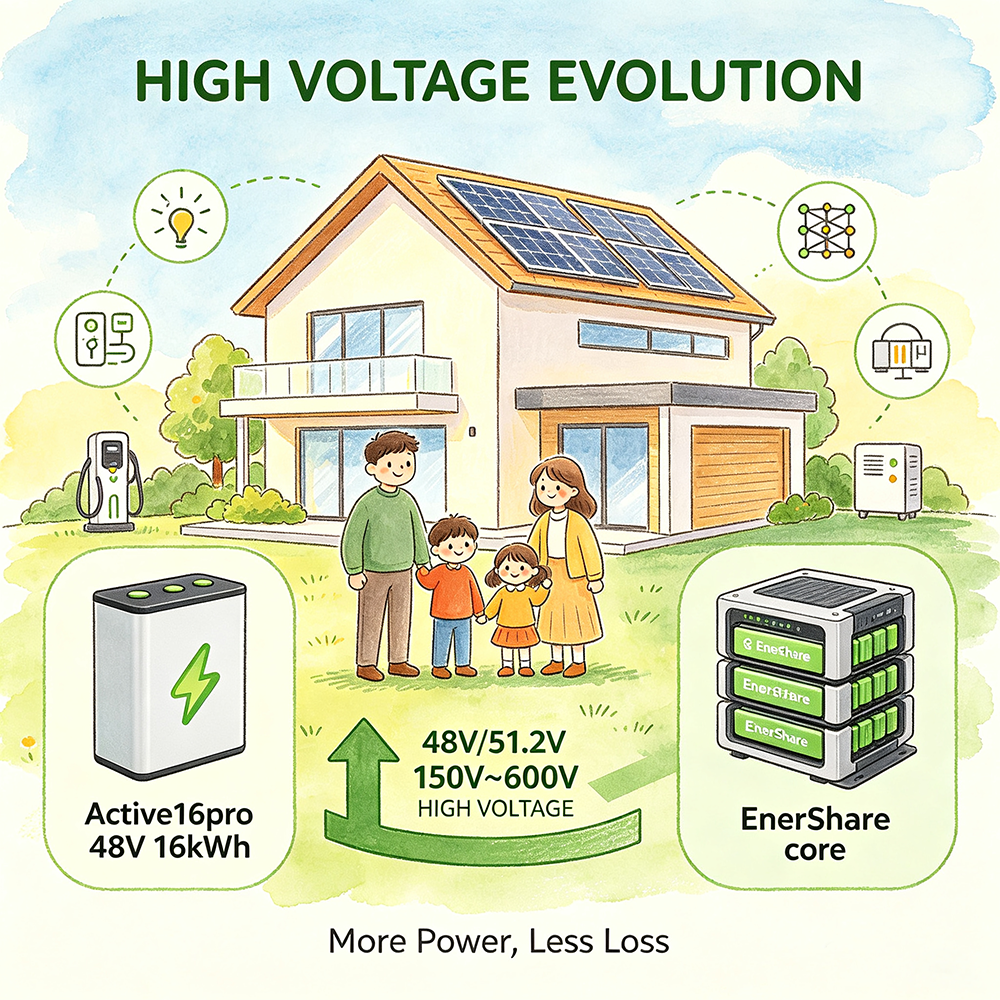
Against the backdrop of growing global residential PV adoption, high-power household appliances, and PV-storage-charging integrated scenarios, the industry is upgrading from traditional 48V/51.2V low-voltage (LV) to 150V–600V high-voltage (HV). This is not a marketing gimmick — it is an engineering necessity driven by power-transmission physics, topology compatibility, load evolution, and technology maturity. It is also the core pathway to reduce LCOE and improve commercial value.
Underlying Physical Driver
The physical foundation for voltage upgrades lies in fundamental laws of electric power transmission:
Where P = transmitted power, V = system voltage, I = current, Ploss = Joule heating loss, and R = line resistance. For fixed power, voltage and current are inversely proportional, while loss scales with the square of current. A moderate voltage increase delivers a large current reduction, cutting thermal losses geometrically.
The drawbacks of 48V LV storage become severe under high power. Take the 5.12KWh Lithium Ion Battery Pack iMAX-100 as an example: at 10kW, bus current reaches 208.3A. This demands 35–50mm² heavy copper cables, high-spec connectors, breakers and relays. Even with proper hardware, cable and joint heating is unavoidable — generating thermal losses, wasting electricity, accelerating ageing, and creating safety hazards.
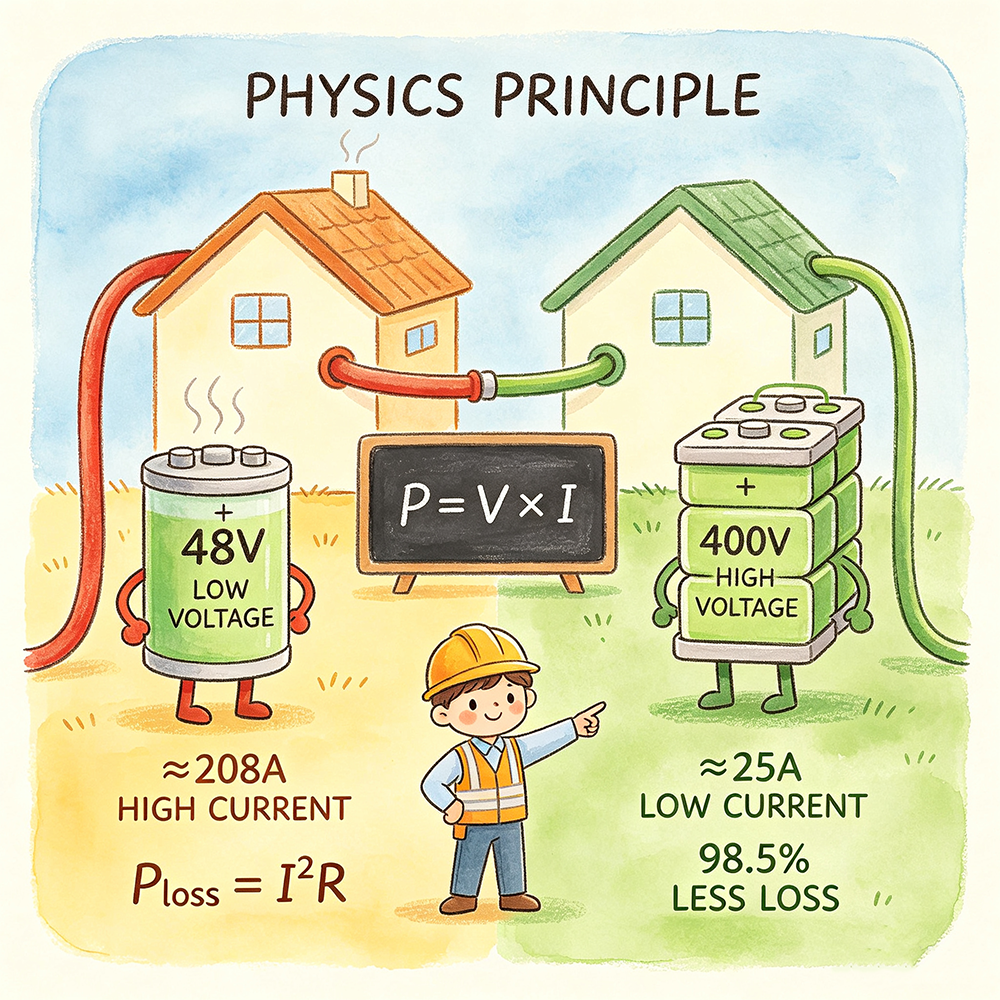
In contrast, a 400V HV system (EnerShare core reference) at 10kW draws only 25A — an 87%+ current reduction. Joule loss is merely 1.44% of the 48V system, a 98.5%+ overall reduction. Standard 4mm² cables suffice, eliminating bulky wiring. Physically, HV resolves the LV triad: high loss, excessive heating, and exorbitant hardware.
Topology Architecture Optimization
Residential PV and household grids operate in a "high-voltage ecosystem": PV strings output 300–600V DC; 220V/380V AC grids correspond to 380–400V inverter DC buses. This creates severe mismatch for 48V batteries.
The LV energy-conversion chain is long and loss-prone:
Two large-ratio conversion stages trigger cumulative magnetic-core loss, switching conduction loss, and thermal dissipation. Even premium models like the iMAX-100 cannot overcome this — RTE is only 91–94%, with clean PV energy wasted as heat.
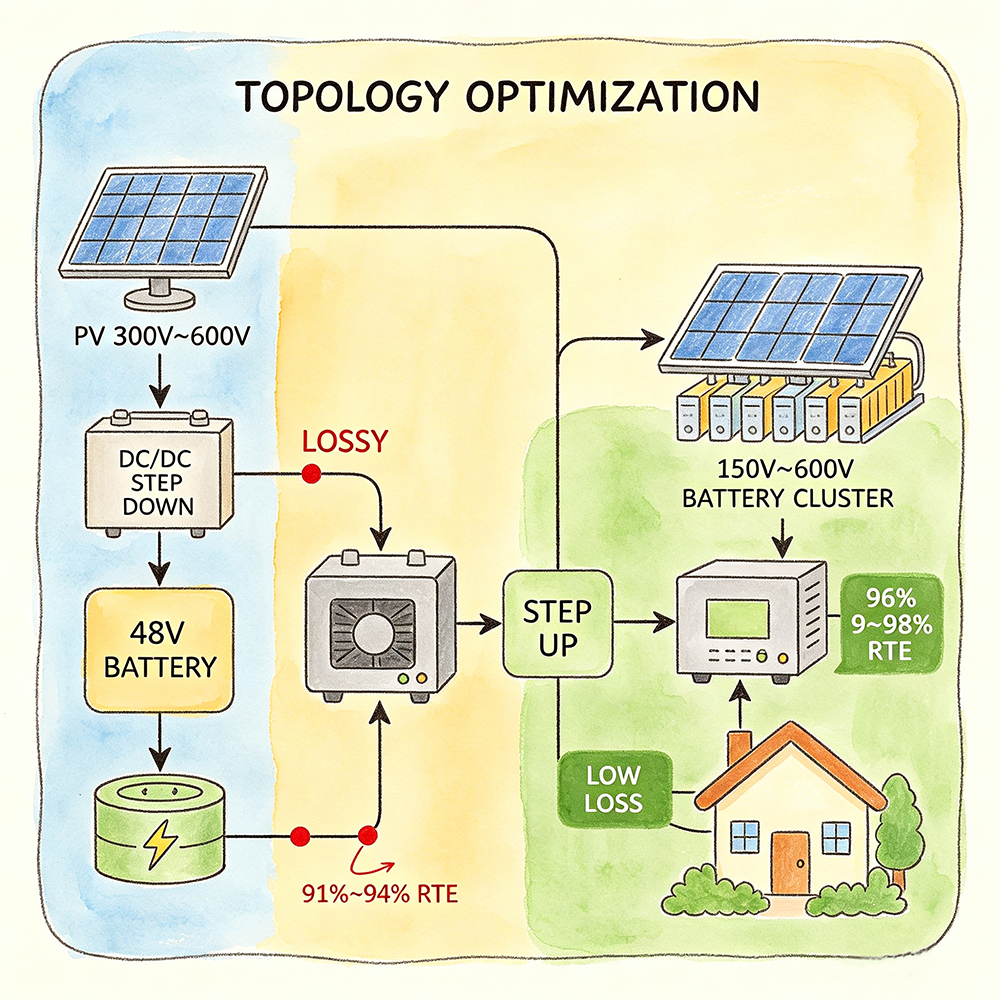
HV architectures (150–600V) align closely with PV and inverter bus levels. Large-ratio DC-DC is usually unnecessary — minor trimming or direct bus connection suffices. This simplifies the chain and cuts conversion losses at source. EnerShare core stabilizes RTE at 96–98%, a qualitative leap in energy utilization.
Enhanced Application Capability
Heat pumps, induction cooktops, and home EV chargers are pushing residential storage from 3–5kW backup to 10–20kW+. HV is the optimal engineering solution.
48V systems hit hard scaling limits. The iMAX-100 exceeds 300A at 15kW — far above standard component ratings. Relays, breakers, and MOSFETs must be over-specified, inflating BOM cost, degrading reliability, and raising failure rates. All LV products are restricted to ≤5kW backup and cannot support high-power loads.
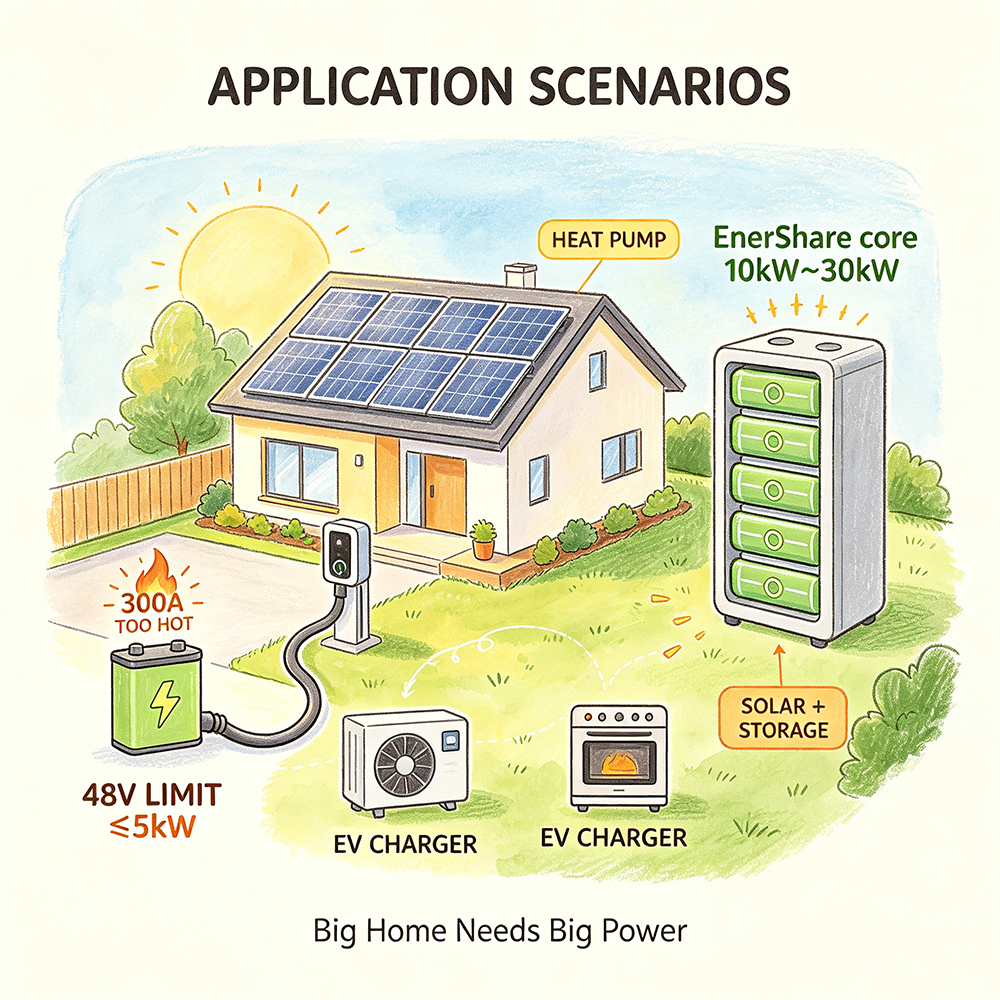
HV scales rationally by raising voltage via series cell stacking, not current. 10–30kW is readily achievable. EnerShare core's modular stackable design avoids overload, overheating, and stability risks — perfectly matching large-home usage, EV charging, and PV-storage-charging integration.
Industrial-Technology Maturity
Early LV dominance came from low safety barriers: 48V is SELV (<60V), needing no HV isolation; only 16 cells; simple BMS. But EV innovation has matured HV tech and democratized costs.
400V/800V EV platforms are mass-produced. Proven HV battery control has migrated to residential storage. Active-passive balancing and precision voltage-temperature monitoring govern every cell, sustaining consistency and preventing faults.
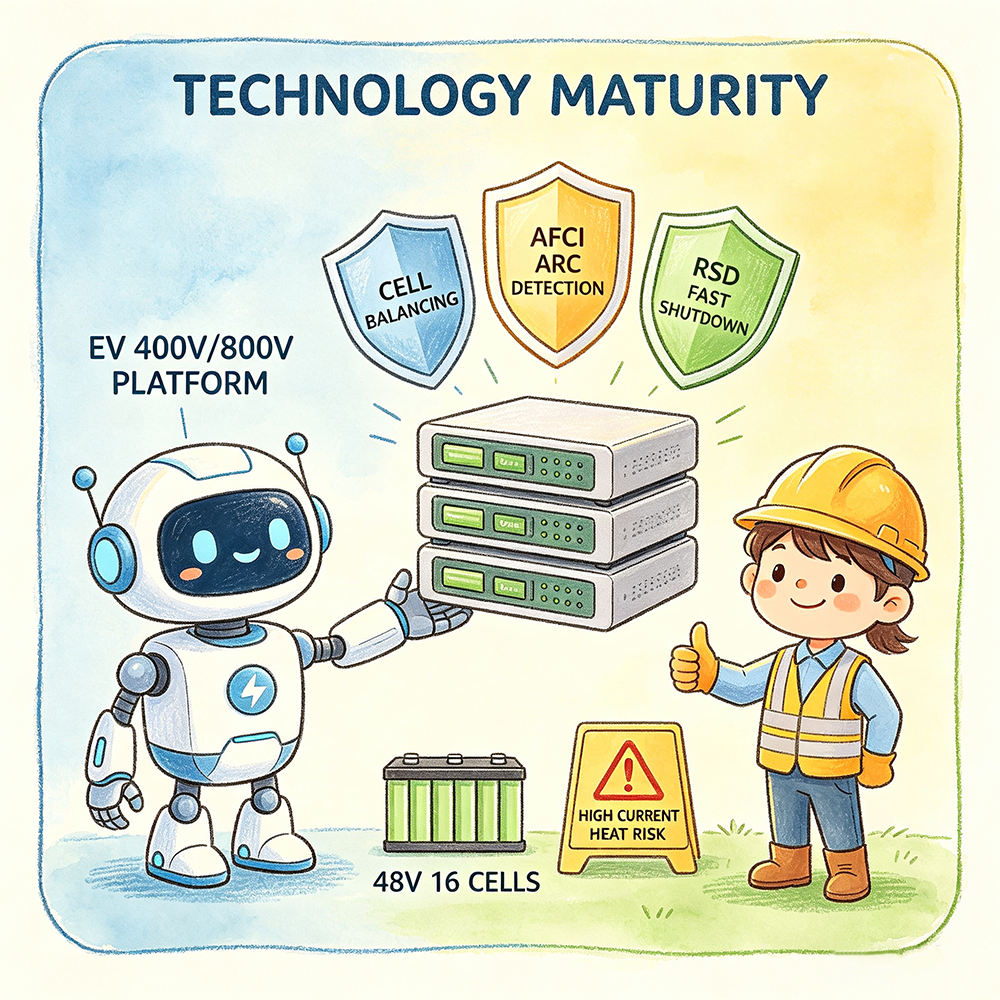
Vehicle-grade spill-over enables HV residential storage to deliver high efficiency + high power + robust safety, comprehensively outperforming LV alternatives.
Core Technical Indicators
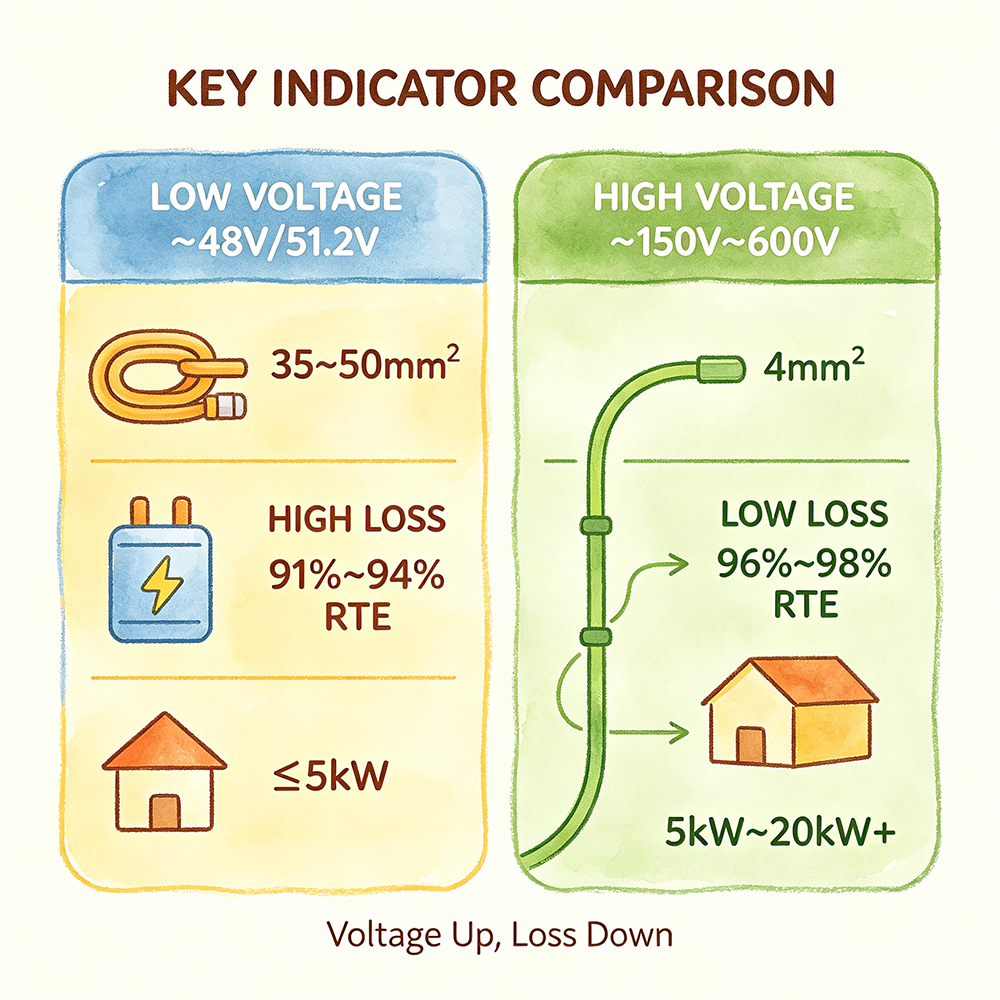
| Dimension | Low-Voltage (~48V) | High-Voltage (~150–600V) |
|---|---|---|
| Current @10kW | ~208A; oversized heavy copper & expensive terminals | ~25A; lightweight standard cables |
| DC/DC Conversion | Large-ratio; severe core & switching losses | Minor trim or direct bus; minimal loss |
| System RTE | 91% – 94% | 96% – 98% |
| Power Range | ≤5kW; basic backup only | 5–20kW+; large home, EV, integration |
| Installation | Thick rigid wires; labor-intensive; costly | Thin-light wires; plug-and-play; simple |
| BMS & Safety | Very low; 16 cells; inherent LV safety | HV isolation, active balance, arc-fault layers |
Full-Dimensional Economic Restructuring
1. Upfront Hardware Cost
At identical power, 400V current is ~1/8 of 48V. The iMAX-100 demands 35–50mm² heavy copper + high-current connectors. EnerShare core needs only 4mm² standard cables. Copper & connector costs drop 60–80%. HV also eliminates costly large-ratio transformers and high-current MOSFETs.
2. Installation Labor Cost
In Europe, North America, and Australia, electricians cost USD 80–150/hr. LV installation takes 4–6 hours (thick cables, combiner boxes, commissioning). HV stack-modular plug-and-play with blind-mate connectors cuts this to 1–2 hours, saving >50% labor.
3. Long-Term Operational Gains
RTE lifts from ~92% to ~97%. A 10kWh system cycled daily at USD 0.055/kWh yields ~180kWh extra/year. Over 10 years, that's hundreds of dollars in arbitrage revenue. Lower current also reduces thermal stress, slowing cell fade and extending cycle life.
4. Future Expansion Cost
LV upgrades may require new inverters, combiners, and re-laying heavy cables. HV simply stacks extra modules in series — host and wiring untouched. Marginal cost stays ultra-low, matching gradual demand growth.
Economic Summary
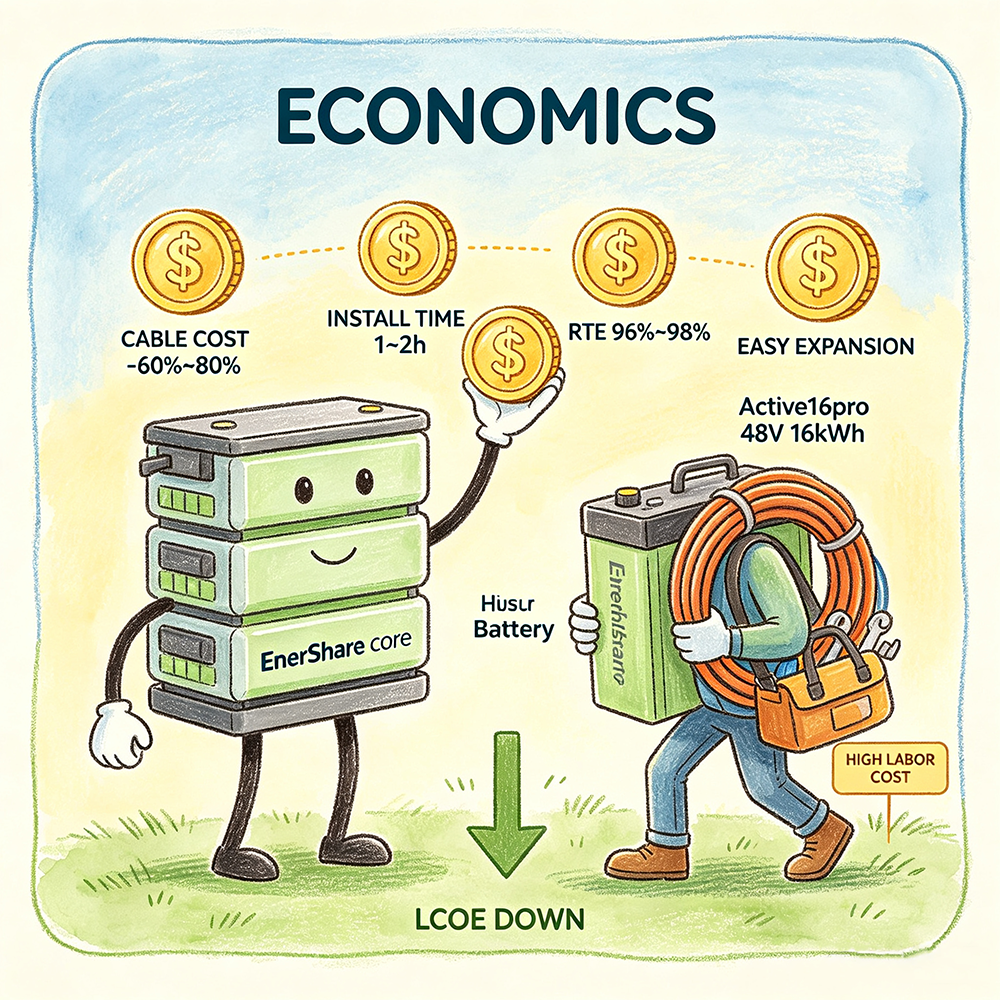
| Dimension | Low-Voltage (~48V) | High-Voltage (~400V) | Impact |
|---|---|---|---|
| Cable & Copper | High; 35–50mm² heavy cables | Low; 4mm² standard cables | >60% BOM reduction |
| Labor Cost | High; 4–6 hrs complex work | Low; 1–2 hrs fast setup | >50% hours saved |
| RTE Efficiency | 91–94% | 96–98% | Extra 10-year revenue |
| High-Power $/W | Surges above 5kW | Improves 8–20kW+ | Superior cost-effectiveness |
Conclusion
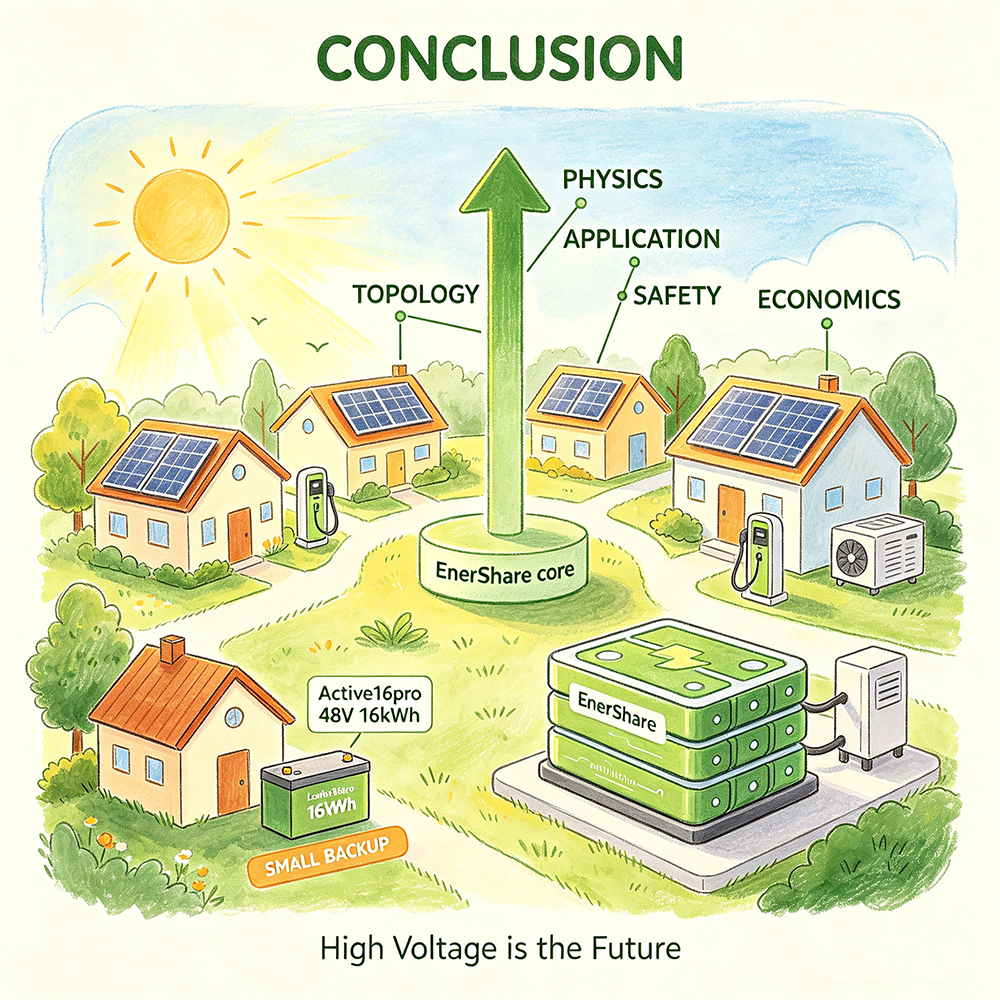
The 5.12KWh Lithium Ion Battery Pack iMAX-100 and other 48V systems are limited to early small-load, low-budget backup. They suffer high loss, mediocre efficiency, poor expandability, and high comprehensive cost.
The rise of EnerShare core and HV architectures is driven by five inevitable forces: physical principles, topological compatibility, application evolution, technology maturity, and economic optimality.